
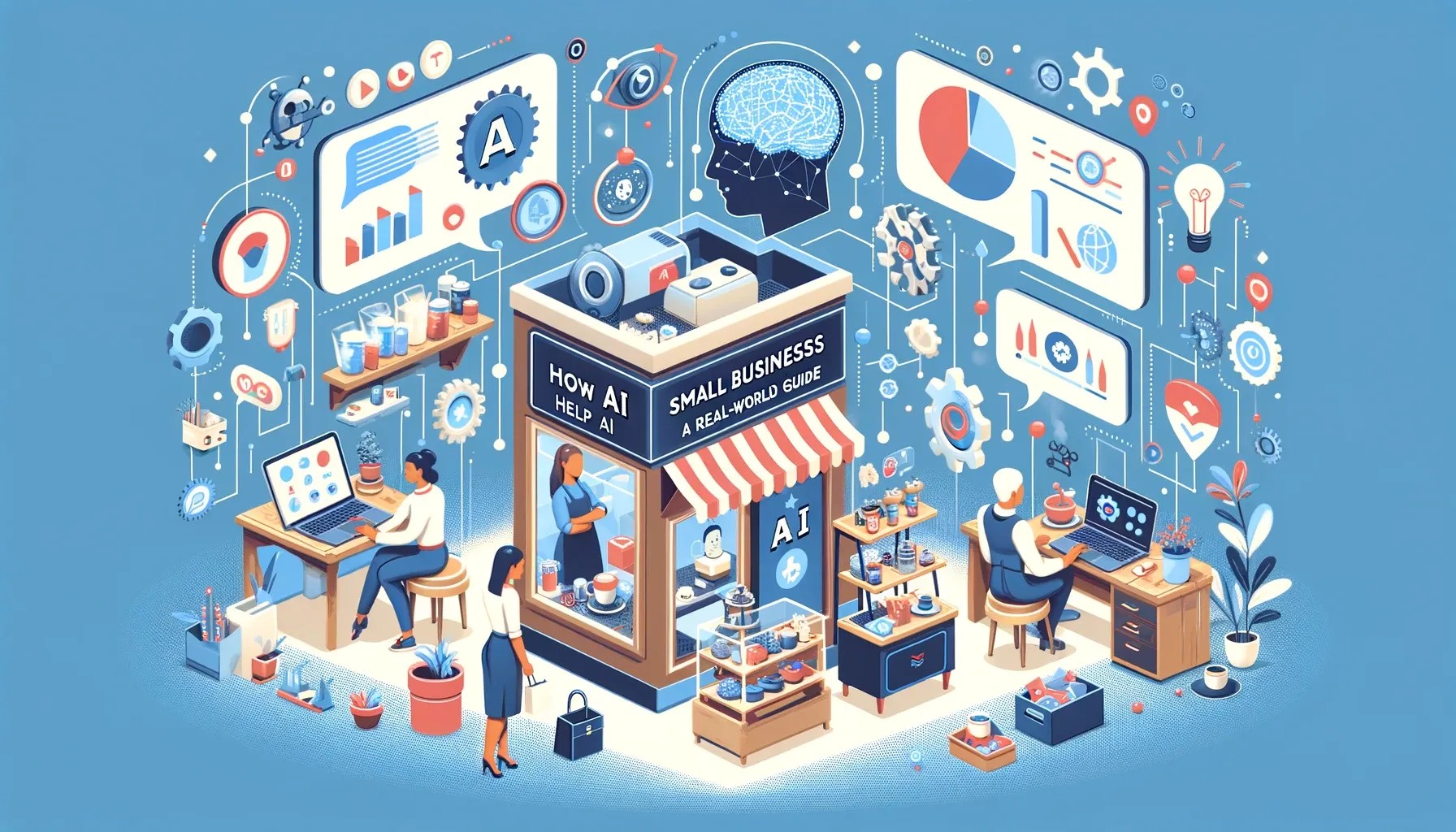
Disclosure: The blog article below was created using AI for the purpose of demonstrating and commenting on the practical use of AI in business. I have manually added commentary in blue to the article where I believe a point should be made.
5 Realistic Ways AI Helps Businesses and 5 Ways It Falls Short
Artificial intelligence has become one of the most talked-about business technologies of the decade. Yet many small and mid-sized businesses still wonder what AI can actually do for them in the real world. While AI can offer powerful advantages, not every application lives up to the hype. Some tools deliver measurable value while others create more work than they solve.
This guide breaks down 5 ways AI realistically benefits businesses and 5 ways AI has proven not useful so you can make smarter decisions before investing in new tools.
5 Realistic Ways AI Helps Businesses
1. Automation of Repetitive Tasks
AI can quickly take over work that eats away at employee time. Tasks like data entry, appointment reminders or sorting emails can be offloaded to automation tools so teams can focus on revenue-driving work instead of simple admin chores. Any data entry performed by AI should be audited for accuracy of course.
2. Faster Customer Support
AI chatbots and helpdesk assistants can answer common customer questions 24/7. They reduce ticket volume, shorten response times and free staff to handle complex issues that require a human touch. I like this concept, but only if the AI chatbot is pre-populated with a database of correct answers. An AI chatbot representing a business should never lookup the answer outside of a controlled set of answers.
3. Improved Decision Making
AI systems can analyze large amounts of data faster than traditional reporting tools. Businesses can use this to identify trends, reduce waste, catch risks early or predict customer behavior.
4. Better Marketing Personalization
AI can tailor email content, product recommendations or ad targeting based on customer behavior. This often leads to higher engagement and better conversions without increasing advertising spend. This advantage relies on advanced algorithms that are usually, but not always outside the financial reach of small businesses.
5. Enhanced Cybersecurity
AI-powered security platforms can detect suspicious activity faster than human monitoring. They help block attacks, flag unusual logins and reduce the chance of data breaches that could harm a business.
5 Ways AI Has Proven Not Useful in Certain Business Applications
1. Overly Generic Chatbots
Many businesses added chatbots expecting a full support replacement. Instead, generic chatbots often frustrate customers because they can’t handle real questions or provide accurate answers. This is one of the most frequently seen failures of AI that is adopted as a flashy trend and not a useful tool.
2. Predictive Tools Without Quality Data
AI cannot make good decisions when the data behind it is inaccurate or incomplete. Businesses that implement AI forecasting with poor data usually get confusing or useless results. Data in = Data out. This is another common point of failure for businesses who feel they need to adopt AI for its implied image of being on the cutting edge of technology rather than its use as a practical tool.
3. AI That Replaces Creative Work
Tools marketed as “instant content creators” often produce repetitive, low-quality writing or images. They still require human editing to meet brand standards. Case in point – this article and these comments illustrate just some of the reasons. Look at the AI generated image for this article. What a mess!
4. Automation That Adds Complexity
Some AI systems need extensive setup, training or integration. Instead of saving time, they create more work for employees who must constantly adjust or troubleshoot the system. My guess is that a high percentage of the new AI assistants in operating systems like Windows and MacOS, as well as everyday productivity tools like Microsoft Office, web browsers, etc. sit idle and ignored since few business know how to use them let alone train their employees on their use!
5. AI That Doesn’t Fit the Business Model
AI platforms designed for enterprise workflows rarely work well for small businesses. When companies adopt tools that aren’t sized for their needs, the technology sits unused or becomes a costly distraction.
Conclusion
AI can absolutely benefit businesses when applied in the right situations, with the right data and with realistic expectations. It’s not a magic solution, but a tool that works best when paired with human judgment. Knowing where AI delivers value and where it consistently falls short helps business owners make smarter, more strategic technology decisions.
I admit to being an AI skeptic and slow adopter. I like to keep abreast of new technologies and learn what I can to make informed decisions and give useful advice. So far, AI has not found a relevant place in my own business on an everyday basis, although there are plenty of vendors who are trying to convince me otherwise. My advice is to take small steps and learn the basics before leaping into the AI pool.
Want to learn more about AI and how to use various AI tools? Infinity Networking has partnered with Bigger Brains to offer best-in-class training across a spectrum of subjects that includes AI.
Here is a sample of a basic AI course offered by Bigger Brains: https://www.youtube.com/watch?v=a7V4vW2ubGs
Feel free to browse the full catalog of courses HERE.